We don’t NEARLY cover enough glass artists making amazing glass art these days, so today we’d like to change that with bringing you the work of Jeff Zimmerman. We spotted some of his pieces on 1stdibs not too long ago and we were completely blown away (pun intended!) by his modern take on this ancient art. Read on for more information about him.
The first pieces we came across of Zimmerman’s are his "Biomorphic bubble,” "Crinkled Series,” and “Sculptural bottle.” It was clear we were dealing with an amazing glass artist, not only from his obvious mastery of the material, but his post-modern take on themes and the way he uses the material. His “Biomorphic Bubble” just absolutely transcends glass art as merely functional, and gives it an ethereal, artistic touch that we rarely see anymore. All glass is delicate, of course, but this piece looks like it could blow away if you blew too hard. Partnering that with illumination, and you get a very powerful piece.
While he definitely creates art for art and sculptural sake, many of the pieces he works on do have the element of functionality, mainly in light fixtures. Perhaps it’s because of glass’ already very light transmitting nature.
Born in Kentucky in 1968, his mother was a painter and his step-father a sculptor, ensuring he was raised in a very creative household. Raised in Colorado, early exposure to nature has been a pivotal part of his work. He took his first glass-blowing class while going toward a degree in Anthropology in Santa Barbara, California, and never looked back. He exposed himself early to the glassworks of the masters of glass blowing, so he doesn’t just work in his own style; he has the expertise of the masters backing up his technique and style. Very influenced by other contemporary glass artists, he was able to approach glass in a different way than classical masters do. Now hailing from Brooklyn, New York, his work is really inspiring many contemporary glass artists. It is certainly inspiring us!
Love what you see in this post but want more? Like fun perfect pairs, designer influence profiles and profiles of contemporary designers? Thank goodness for you we’ve got a Facebook page and tweet a lot; you can keep up with everything Swank Lighting does.
Showing posts with label Glass artists. Show all posts
Friday, October 8, 2010
Wednesday, September 22, 2010
New Rock Candy Chandeliers with Dana Strickland!
Have you heard? We’ve loved Swank Lighting’s Rock Candy lamp line for awhile now. And what’s not to love? Fabulous chunks of rough-hewn color bring in bold hue and texture into a space when you place a Rock Candy lamp into a living room or dining room—really any room. We’re delighted to announce then, that we’ll be offering our fabulous Rock Candy line as chandeliers! We've had so many requests from designers and home owners that it's time we expanded. We’re not doing it alone—we’ve recruited the fabulous Seattle artist Dana Strickland to create these amazing light fixtures. We’ll let her give the details:
What is your background? What did you graduate in at school? What have you done professionally?
All of my professional training and work has been in special education—I have taught students with severe behavioral and emotional disorders for many years in the public schools and have now been teaching "teachers" at Western Washington University for 10 years. I have a Master's degree in special education and an undergraduate degree in 3 areas—psychology, sociology and criminology.
How did you get connected with the Swank Lighting guys?
I got connected with Swank Lighting through Etsy.com—the website for artists. I had posted two handmade chandeliers and Doug contacted me to see if I thought I could design something for their Rock Candy line. Of course, I love an artistic challenge—one of my favorite things to do is to be presented with an idea—someone saying "Do you think you can make this?"—whether or not it is a 3-D specialty cake or a chandelier or something for an auction at my kid's school. I told Doug "let's go for it" and next thing I know, there is 65 pounds of glass sitting on my front porch!
You'll be specifically working in Swank Lighting's Rock Candy line, including a new line of Rock Candy chandeliers. Will you be working on anything else?
Right now, we are focusing on the rock candy chandeliers—designing and creating some prototypes to see how the public responds to them. Our goal would be for clients to be able to have some options for their chandelier —solid or mixed in many color choices!
Without giving away too many secrets, can you go into a little detail about how you create these gorgeous light fixtures?
The first step in designing the chandelier is finding the right base or "frame" to work on. Once I find it, it just seems to speak to me regarding the color choices and patterns—unless Swank Lighting has requested a specific color mix. I send lots of pics back and forth to Doug and Eddie—making sure we are all on board with size, shape and color. They of course leave the artistic design up to me—however, I receive a lot of joy in producing something that someone else desires but doesn't know how to create ! It is the client's light, of course, and I want it to be what they love and what fits their taste and decor. Then, it's just a matter of patience and I hand pick each piece of glass and adhere it to the base. A large chandelier can take over 100 hours to complete.
What's a typical day like working on Swank Lighting products?
There is no such thing as a typical day working for Swank Lighting—I have 3 kids, a husband and a disabled mother that lives with us. Often, I do my best work late at night—when everyone else is asleep—just listening to Bon Jovi and working for hours while all is still. My husband is a special education teacher as well and so he's home in the summer. It's often during this time that I can work for long stints of time in the day and be very productive.
What's the funnest/most rewarding thing about working with the Rock Candy line?
The funniest part of working with the rock candy line of chandeliers is moving the project while you work on it—we put on our worker gloves, and rotate the thing like a pig on a rotisserie! Then, getting it out to be shipped is a sight to behold! My husband and I moved the last one in a wheelbarrow around the block and into our garage. You should have seen the neighbors stare!
Are there any difficulties with working with the line?
Is is easy or hard to mess up a piece?The difficulties in working with the rock candy line revolve mostly around the sheer weight of the piece when complete. A large chandelier base can weigh 40 pounds or so before you have even applied the glass. Then, once you adhere 60 pounds of glass, you have quite a load as far as moving it goes! The piece has to be constantly rotated to insure even coverage and to allow ample dry time. The whole family is in on that act! The other most significant difficulty has to do with the glass not "sliding" off the base as you allow adequate drying time. More often than not, each piece of glass is secured with painter's tape until the adhesive sets. Because of this, you can only do small, random sections at a time and then work your way around the piece.
If you ever mess up a piece while making it, what do you do with the scraps?
Most of the "mess ups" occur when I don't tape the pieces of glass as they dry and then they fall off sometime that I am not aware and I find them later—covered in a thick adhesive, and most likely, in my dog's mouth!
What are your future plans, either with Swank Lighting or other artistic projects?
Swank lighting and I are designing another type of chandelier—no glass involved! But that is all I can say! Also, I will continue with the chandeliers that first caught Swank lightings' eye—shell chandeliers! They are dear to my heart as my originals have shells that my family and I have collected from the beaches of Florida for the past 15 years. I love the ocean—and the natural beauty of tiny shells—and so these chandeliers make me feel relaxed and connected to the earth. In addition, I'll be teaching 3rd graders how to sew, bake bread, and make butter and cheese. Throw in a few specialty birthday cakes and handmade auction items for the school, and I'll call it "good".
What is your background? What did you graduate in at school? What have you done professionally?All of my professional training and work has been in special education—I have taught students with severe behavioral and emotional disorders for many years in the public schools and have now been teaching "teachers" at Western Washington University for 10 years. I have a Master's degree in special education and an undergraduate degree in 3 areas—psychology, sociology and criminology.
How did you get connected with the Swank Lighting guys?I got connected with Swank Lighting through Etsy.com—the website for artists. I had posted two handmade chandeliers and Doug contacted me to see if I thought I could design something for their Rock Candy line. Of course, I love an artistic challenge—one of my favorite things to do is to be presented with an idea—someone saying "Do you think you can make this?"—whether or not it is a 3-D specialty cake or a chandelier or something for an auction at my kid's school. I told Doug "let's go for it" and next thing I know, there is 65 pounds of glass sitting on my front porch!
You'll be specifically working in Swank Lighting's Rock Candy line, including a new line of Rock Candy chandeliers. Will you be working on anything else?Right now, we are focusing on the rock candy chandeliers—designing and creating some prototypes to see how the public responds to them. Our goal would be for clients to be able to have some options for their chandelier —solid or mixed in many color choices!
Without giving away too many secrets, can you go into a little detail about how you create these gorgeous light fixtures?
The first step in designing the chandelier is finding the right base or "frame" to work on. Once I find it, it just seems to speak to me regarding the color choices and patterns—unless Swank Lighting has requested a specific color mix. I send lots of pics back and forth to Doug and Eddie—making sure we are all on board with size, shape and color. They of course leave the artistic design up to me—however, I receive a lot of joy in producing something that someone else desires but doesn't know how to create ! It is the client's light, of course, and I want it to be what they love and what fits their taste and decor. Then, it's just a matter of patience and I hand pick each piece of glass and adhere it to the base. A large chandelier can take over 100 hours to complete.
What's a typical day like working on Swank Lighting products?There is no such thing as a typical day working for Swank Lighting—I have 3 kids, a husband and a disabled mother that lives with us. Often, I do my best work late at night—when everyone else is asleep—just listening to Bon Jovi and working for hours while all is still. My husband is a special education teacher as well and so he's home in the summer. It's often during this time that I can work for long stints of time in the day and be very productive.
What's the funnest/most rewarding thing about working with the Rock Candy line?The funniest part of working with the rock candy line of chandeliers is moving the project while you work on it—we put on our worker gloves, and rotate the thing like a pig on a rotisserie! Then, getting it out to be shipped is a sight to behold! My husband and I moved the last one in a wheelbarrow around the block and into our garage. You should have seen the neighbors stare!
Are there any difficulties with working with the line?Is is easy or hard to mess up a piece?The difficulties in working with the rock candy line revolve mostly around the sheer weight of the piece when complete. A large chandelier base can weigh 40 pounds or so before you have even applied the glass. Then, once you adhere 60 pounds of glass, you have quite a load as far as moving it goes! The piece has to be constantly rotated to insure even coverage and to allow ample dry time. The whole family is in on that act! The other most significant difficulty has to do with the glass not "sliding" off the base as you allow adequate drying time. More often than not, each piece of glass is secured with painter's tape until the adhesive sets. Because of this, you can only do small, random sections at a time and then work your way around the piece.
If you ever mess up a piece while making it, what do you do with the scraps?Most of the "mess ups" occur when I don't tape the pieces of glass as they dry and then they fall off sometime that I am not aware and I find them later—covered in a thick adhesive, and most likely, in my dog's mouth!
What are your future plans, either with Swank Lighting or other artistic projects?Swank lighting and I are designing another type of chandelier—no glass involved! But that is all I can say! Also, I will continue with the chandeliers that first caught Swank lightings' eye—shell chandeliers! They are dear to my heart as my originals have shells that my family and I have collected from the beaches of Florida for the past 15 years. I love the ocean—and the natural beauty of tiny shells—and so these chandeliers make me feel relaxed and connected to the earth. In addition, I'll be teaching 3rd graders how to sew, bake bread, and make butter and cheese. Throw in a few specialty birthday cakes and handmade auction items for the school, and I'll call it "good".
Monday, November 23, 2009
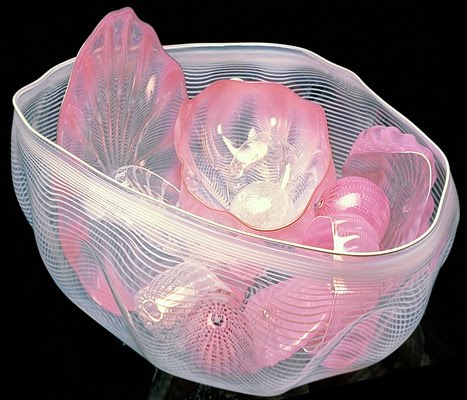
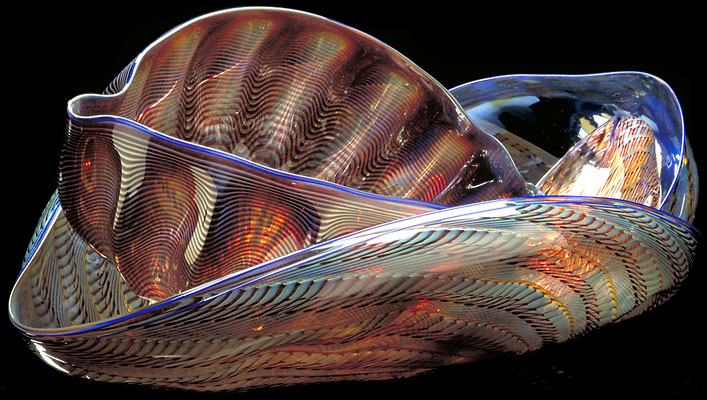
The Bold and Colorful Glass Art of Dale Chihuly!
While we’ve been bringing you some of the best past and contemporary influences in the worlds of architecture and interior, furniture and industrial design, we’re getting back to the basics and bringing you a stunning and supremely talented glass artist. Dale Chihuly’s body of work is so varied and wide-ranging it’s hard to classify, but there’s no doubt of his influence on the field of glass art, and really, art in general.


Born in Tacoma, Washington in 1941, his school background is diverse and impressive: he enrolled at the College of the Puget Sound in 1959, later transferring to the University of Washington at Seattle where he graduated in 1965 with a degree in interior design. His life changing moment came in 1964, however, when he was introduced to the art of glass. Being introduced to blowing glass, he continued with his education, receiving a Master of Science in sculpture from the University of Wisconsin-Madison. He studied glass in Venice on a Fulbright Fellowship and then went on to earn a Master of Fine Arts at the Rhode Island School of Design. Obviously not one to slow down, he helped establish a glass program at RISD and went on to start his own school, the Pilchuck Glass School.


As a teacher and an early artist, Chihuly first began to grab attention with his glass work on a number of temporary glass art pieces, as well as for his reputation for collaboration with artists of other media. He encouraged his students to approach glass from unorthodox perspectives, and this often produced important revelations in the glass world. Chihuly was very interested in glass as a form of sculpture and he focused often on that most ancient of accessories, the vessel. Through sculpture and his vessels he explores color, shape, pattern and form. Often described as not having the most complex of blowing techniques, Chihuly allowed glass to find its own shape and he used minimal tools.


He’s created numerous series throughout the year, among them “Baskets”, featuring translucent orbs in bowl-shapes, “Persians”, with lots of wavy colored lines throughout the glass, and our personal favorite, “Sea Forms”, gorgeous, jellyfish-like shapes. Chihuly is also known for his inspiring large-scale installations, like large glass “floats” in water, glass forests and flowers, and even homage to Italian glass with “Chihuly Over Venice.”


To honestly sum up all of Chihuly’s work in one article would be futile—the man’s work has been prolific, and he continues to teach and create even until today. Though car and surfing accidents have left him unable to do the work himself, Chihuly currently guides and directs a team of fellow artisans and is still leaving his imprint on the world of glass.


Born in Tacoma, Washington in 1941, his school background is diverse and impressive: he enrolled at the College of the Puget Sound in 1959, later transferring to the University of Washington at Seattle where he graduated in 1965 with a degree in interior design. His life changing moment came in 1964, however, when he was introduced to the art of glass. Being introduced to blowing glass, he continued with his education, receiving a Master of Science in sculpture from the University of Wisconsin-Madison. He studied glass in Venice on a Fulbright Fellowship and then went on to earn a Master of Fine Arts at the Rhode Island School of Design. Obviously not one to slow down, he helped establish a glass program at RISD and went on to start his own school, the Pilchuck Glass School.


As a teacher and an early artist, Chihuly first began to grab attention with his glass work on a number of temporary glass art pieces, as well as for his reputation for collaboration with artists of other media. He encouraged his students to approach glass from unorthodox perspectives, and this often produced important revelations in the glass world. Chihuly was very interested in glass as a form of sculpture and he focused often on that most ancient of accessories, the vessel. Through sculpture and his vessels he explores color, shape, pattern and form. Often described as not having the most complex of blowing techniques, Chihuly allowed glass to find its own shape and he used minimal tools.

He’s created numerous series throughout the year, among them “Baskets”, featuring translucent orbs in bowl-shapes, “Persians”, with lots of wavy colored lines throughout the glass, and our personal favorite, “Sea Forms”, gorgeous, jellyfish-like shapes. Chihuly is also known for his inspiring large-scale installations, like large glass “floats” in water, glass forests and flowers, and even homage to Italian glass with “Chihuly Over Venice.”


To honestly sum up all of Chihuly’s work in one article would be futile—the man’s work has been prolific, and he continues to teach and create even until today. Though car and surfing accidents have left him unable to do the work himself, Chihuly currently guides and directs a team of fellow artisans and is still leaving his imprint on the world of glass.Tuesday, October 6, 2009
A Perfect Pair: A Popa Chair and Lavender Berry Lamps!
As you’ve no doubt noticed, we like to take our favorite furniture piece from design influences we post about and combine them with a Swank Lighting lamp to create an irresistible combination. Today’s post is no different! We’ll be combining a Paul McCobb Popa chair and some contemporary hand blown Swank Lighting lamps by Joe Cariati in a fabulous color…


We love a lot of Paul McCobb’s furniture pieces. They just all seem to possess the perfect combination of modern and traditional, and are so simple and stylish. Despite that love, we somehow fell for one of McCobb’s most unique pieces, the upholstered and bold Popa Chair. One of his more luxurious pieces, the Popa Chair almost has a more Hollywood Regency feel to it than a modern feel. A very large and opposing piece, the Popa chair features a large seat with a tall back cushion that is flanked with upholstered wings, that gives a very intimate and cozy feel to the piece. The button tufts add an air of traditional to the piece, and the large, opposing feel of the chair is magnified by the modern, thin, and tapered legs. We even love the color of the upholstery, which is a warm, khaki-colored gray. Overall the piece is masculine.
We’re big fans of Joe Cariati’s glass art, and we think his hand blown glass lamps for Swank Lighting are just gorgeous. His Three Ball Stack lamp in Lavender Berry is a perfect contemporary glass lamp. Tall and featuring three balls stacked on top of one another, the lamps are just great-looking. We’re especially in love with the color. In between pink and lavender, the lamps are shiny and an ultra-feminine color.
Together, these lamps and McCobb chair make a fabulous pair. McCobb’s Popa Chair is opposing, big and a masculine, stylish statement. Swank’s contemporary Cariati lamps are wonderfully bright, cheery and feminine. Side by side they are a study in opposites: the Popa Chair is wide and large, the lamps are tall and skinny. The Popa Chair is cozy and with matte upholstery; the lamps are shiny, glossy and refuse to stand in the background. As we’ve seen before, these two home décor items go so well together because they are dissimilar, and their differences make for a dynamic combination!


We love a lot of Paul McCobb’s furniture pieces. They just all seem to possess the perfect combination of modern and traditional, and are so simple and stylish. Despite that love, we somehow fell for one of McCobb’s most unique pieces, the upholstered and bold Popa Chair. One of his more luxurious pieces, the Popa Chair almost has a more Hollywood Regency feel to it than a modern feel. A very large and opposing piece, the Popa chair features a large seat with a tall back cushion that is flanked with upholstered wings, that gives a very intimate and cozy feel to the piece. The button tufts add an air of traditional to the piece, and the large, opposing feel of the chair is magnified by the modern, thin, and tapered legs. We even love the color of the upholstery, which is a warm, khaki-colored gray. Overall the piece is masculine.
We’re big fans of Joe Cariati’s glass art, and we think his hand blown glass lamps for Swank Lighting are just gorgeous. His Three Ball Stack lamp in Lavender Berry is a perfect contemporary glass lamp. Tall and featuring three balls stacked on top of one another, the lamps are just great-looking. We’re especially in love with the color. In between pink and lavender, the lamps are shiny and an ultra-feminine color.
Together, these lamps and McCobb chair make a fabulous pair. McCobb’s Popa Chair is opposing, big and a masculine, stylish statement. Swank’s contemporary Cariati lamps are wonderfully bright, cheery and feminine. Side by side they are a study in opposites: the Popa Chair is wide and large, the lamps are tall and skinny. The Popa Chair is cozy and with matte upholstery; the lamps are shiny, glossy and refuse to stand in the background. As we’ve seen before, these two home décor items go so well together because they are dissimilar, and their differences make for a dynamic combination! Monday, August 3, 2009
The Look of Lucite!
If you’re just discovering Swank Lighting’s gorgeous array of vintage Murano glass lamps and contemporary glass art lamps, you might not be familiar with their serendipitous beginning. You can read a full history on their about page, but to sum it up: Ed and Doug came across an absolute treasure trove of crates of vintage Murano glass lamps a few years ago---and bought the entire inventory then and there!

While the glass only needed a bit of cleaning, the rest of the lamps were in dire need of restoration. Lamps would have to be rewired for safety codes and aesthetics, and many of the other lamps parts had to be replaced. Namely, the bases. The original bases were one of either three materials: brass, wood or pot metal. And while they were no doubt beautiful when the lamps first began their lives, after being stored for so long, the original bases didn’t fare so well.
Next up was the decision to decide which types of bases to put on the newly rewired and restored lamps. Taking many factors into consideration, the Swank Lighting lamp experts went with a versatile little material called Lucite.


Hard, clear and oh-so-pretty, Lucite is a great material to use for a lamp base for many reasons. It’s sturdy and strong, ensuring that it will support your lamp securely, but it’s also fairly decent at thwarting dents, cracks, chips and scratches. Being clear-colored, it goes with any other material, either on the lamp or in your space. Instead of taking away from the beauty of the glass, a Lucite base allows for the lamp to visually become the art of the piece, as it was intended to be!

If it seems off to put a modern material on a vintage lamp---Lucite’s not that modern! In fact, many important designers in the past used Lucite as an accent in interiors, like William Haines and James Mont. By 1945, it had already become a popular material in high-end furniture. Sleek, strong and unassuming, Lucite is a perfect accent for ANY style of décor in your home.

While the glass only needed a bit of cleaning, the rest of the lamps were in dire need of restoration. Lamps would have to be rewired for safety codes and aesthetics, and many of the other lamps parts had to be replaced. Namely, the bases. The original bases were one of either three materials: brass, wood or pot metal. And while they were no doubt beautiful when the lamps first began their lives, after being stored for so long, the original bases didn’t fare so well.
Next up was the decision to decide which types of bases to put on the newly rewired and restored lamps. Taking many factors into consideration, the Swank Lighting lamp experts went with a versatile little material called Lucite.

Hard, clear and oh-so-pretty, Lucite is a great material to use for a lamp base for many reasons. It’s sturdy and strong, ensuring that it will support your lamp securely, but it’s also fairly decent at thwarting dents, cracks, chips and scratches. Being clear-colored, it goes with any other material, either on the lamp or in your space. Instead of taking away from the beauty of the glass, a Lucite base allows for the lamp to visually become the art of the piece, as it was intended to be!
If it seems off to put a modern material on a vintage lamp---Lucite’s not that modern! In fact, many important designers in the past used Lucite as an accent in interiors, like William Haines and James Mont. By 1945, it had already become a popular material in high-end furniture. Sleek, strong and unassuming, Lucite is a perfect accent for ANY style of décor in your home. Thursday, July 30, 2009
Swank Lighting Artist Joe Cariati!
If you’ve been to swanklighting.com before, you’re no doubt familiar with the gorgeous glass lamp designs of Joe Cariati, one of our main modern glass lamp artists. Looking at the quality, color and style of his lamps on our site, it should come as no surprise that Cariati’s background is impressive and his other work amazing!
Joe Cariati started out in glassblowing quite by accident. While studying at the San Francisco State University in 1992, he saw someone blowing glass, and thought he should try it! According to Cariati, he picked up the art quickly and has been working with glass for over 17 years now. A good fit from the start, he says his personality and glassblowing go together well, describing the art as “a cross between calculated control, with an element of risk (in relation to making it or breaking it) topped off with a physical engagement (sweating).”
Along with glassblowing, Cariati also creates urban-inspired paintings. When asked when his love of urban art began (as it is evident in viewing his work that he’s a graffiti and street art fan), he admits it began with the 1982 NYC graffiti artist documentary “Style Wars”. Going to high school in Santa Monica, he also befriended other graffiti artists his age who helped show him the ropes. As he puts it, “mostly, as I found out later, I was interested in 'place', not necessarily the action of graffiti, but the surrounding detritus and activity of the urban landscape. Ultimately, this phenomenon is what my painting is about.”

So when did his hobbies of glass blowing and urban art translate into a career? Cariati confesses he didn’t quite start trying to make money until he was already a bit in debt (characterizing himself as a typical “idealistic young adult”), but after 9/11, he had his first solo painting exhibition (though he didn’t quite sell anything). After a review in ArtWeek, his work began to get noticed, but still no sales. He took a chance with glassblowing soon after, debuting a line of wine bottles in opaque colors. As he calls it: “This was about the time the new modern 'look' was running rampant, and I saw a void in the market and filled it. I snagged ten accounts in the Bay Area and LA and started making some money.” He says he now has over 50 accounts that carry his work, from major stores like Barney's to smaller boutique stores like OK in Los Angeles.
Like many artists who work in different media, Cariati doesn’t choose a favorite between glass blowing and painting: “Glassblowing is "high tech". It requires a ton of money per day, a crew of 3-4 people. It's noisy, dirty and very physical. It's extremely stressful at times if things aren't going your way. Painting for me is the polar opposite: it's "low-tech". Painting is an affordable, quiet, very forgiving medium that you can get lost in by yourself.”
His current line of glassware is stunning, both in its form and its style. Delicately transparent with sharp edges and shapes, yet also equally curving, his decanters and vases have exaggerated forms, and it’s their contrast with their backgrounds that really set them apart from other glass work being produced at this time. More than just pretty forms, his work has a great concept: some of it’s inspired by pure forms derived from the cylinder, sphere and cone, and connected to the important influence of Cubist paintings.

“This type of research into Cubism was born out of a residency I had in the Bay Area, I think it was the first time that I was looking at another medium entirely (paint) for influencing my glass work. It was exciting and carried over into a lot of work I made during that time. Lately, I've referenced the look and flavor of American Glass in the 1960's, the decanters are born out of an interest to uphold and improve upon a legacy of American Glass designs...back to basics.”
As for the future, Cariati is looking forward to meeting with Swank Lighting in April to talk about a new line of lamps that will be more similar to his new line of glass. He’s also working on another, more “low-tech” lighting project: he’s developing a line of candle holders that are reminiscent of wine and liquor bottles used as candle holders. He also continues to teach the art of glass making, stressing the hand skills, experimentation and material exploration, research, drawing, writing, and professional practices that have characterized his 17 years of successful glass work. You can learn more about Cariati on his website, joecariati.com.
Joe Cariati started out in glassblowing quite by accident. While studying at the San Francisco State University in 1992, he saw someone blowing glass, and thought he should try it! According to Cariati, he picked up the art quickly and has been working with glass for over 17 years now. A good fit from the start, he says his personality and glassblowing go together well, describing the art as “a cross between calculated control, with an element of risk (in relation to making it or breaking it) topped off with a physical engagement (sweating).”
Along with glassblowing, Cariati also creates urban-inspired paintings. When asked when his love of urban art began (as it is evident in viewing his work that he’s a graffiti and street art fan), he admits it began with the 1982 NYC graffiti artist documentary “Style Wars”. Going to high school in Santa Monica, he also befriended other graffiti artists his age who helped show him the ropes. As he puts it, “mostly, as I found out later, I was interested in 'place', not necessarily the action of graffiti, but the surrounding detritus and activity of the urban landscape. Ultimately, this phenomenon is what my painting is about.”
So when did his hobbies of glass blowing and urban art translate into a career? Cariati confesses he didn’t quite start trying to make money until he was already a bit in debt (characterizing himself as a typical “idealistic young adult”), but after 9/11, he had his first solo painting exhibition (though he didn’t quite sell anything). After a review in ArtWeek, his work began to get noticed, but still no sales. He took a chance with glassblowing soon after, debuting a line of wine bottles in opaque colors. As he calls it: “This was about the time the new modern 'look' was running rampant, and I saw a void in the market and filled it. I snagged ten accounts in the Bay Area and LA and started making some money.” He says he now has over 50 accounts that carry his work, from major stores like Barney's to smaller boutique stores like OK in Los Angeles.
Like many artists who work in different media, Cariati doesn’t choose a favorite between glass blowing and painting: “Glassblowing is "high tech". It requires a ton of money per day, a crew of 3-4 people. It's noisy, dirty and very physical. It's extremely stressful at times if things aren't going your way. Painting for me is the polar opposite: it's "low-tech". Painting is an affordable, quiet, very forgiving medium that you can get lost in by yourself.”
His current line of glassware is stunning, both in its form and its style. Delicately transparent with sharp edges and shapes, yet also equally curving, his decanters and vases have exaggerated forms, and it’s their contrast with their backgrounds that really set them apart from other glass work being produced at this time. More than just pretty forms, his work has a great concept: some of it’s inspired by pure forms derived from the cylinder, sphere and cone, and connected to the important influence of Cubist paintings.
“This type of research into Cubism was born out of a residency I had in the Bay Area, I think it was the first time that I was looking at another medium entirely (paint) for influencing my glass work. It was exciting and carried over into a lot of work I made during that time. Lately, I've referenced the look and flavor of American Glass in the 1960's, the decanters are born out of an interest to uphold and improve upon a legacy of American Glass designs...back to basics.”
As for the future, Cariati is looking forward to meeting with Swank Lighting in April to talk about a new line of lamps that will be more similar to his new line of glass. He’s also working on another, more “low-tech” lighting project: he’s developing a line of candle holders that are reminiscent of wine and liquor bottles used as candle holders. He also continues to teach the art of glass making, stressing the hand skills, experimentation and material exploration, research, drawing, writing, and professional practices that have characterized his 17 years of successful glass work. You can learn more about Cariati on his website, joecariati.com.
Subscribe to:
Posts (Atom)